It looks like you want a complete blog article. Here’s a polished, SEO-friendly version that you can publish on your website.
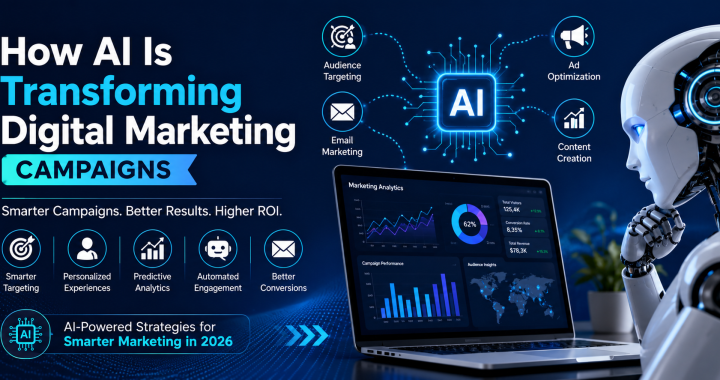
How AI Is Transforming Digital Marketing Campaigns in 2026
Artificial Intelligence (AI) has become one of the most influential technologies in the digital marketing industry. What once required hours of manual work can now be completed in minutes with the help of AI-powered tools. From content creation and customer support to audience targeting and campaign optimization, AI is reshaping the way businesses connect with their customers.
In 2026, digital marketing is no longer just about running ads or posting on social media. Businesses are using AI to analyze customer behavior, personalize experiences, predict trends, and improve return on investment (ROI). Whether you’re a startup, a small business, or a global brand, integrating AI into your marketing strategy can help you work smarter, reduce costs, and achieve better results.
In this guide, we’ll explore how AI is transforming digital marketing campaigns, its benefits, popular applications, challenges, and what marketers should expect in the future.
What Is AI in Digital Marketing?
Artificial Intelligence in digital marketing refers to the use of machine learning, natural language processing (NLP), predictive analytics, and automation to improve marketing activities. AI helps marketers collect and analyze vast amounts of data, automate repetitive tasks, and make data-driven decisions faster than ever before.
Instead of relying on guesswork, marketers can now use AI to understand customer preferences, predict buying behavior, and deliver personalized experiences.
Why AI Matters in Modern Marketing
Consumer expectations have changed dramatically. People expect brands to provide personalized experiences, instant responses, and relevant recommendations. AI makes this possible by processing customer data in real time and delivering the right message to the right audience.
Some major reasons businesses are adopting AI include:
- Faster campaign optimization
- Better customer targeting
- Improved personalization
- Higher conversion rates
- Reduced marketing costs
- Increased productivity
- Better customer engagement
- Data-driven decision making
How AI Is Transforming Digital Marketing Campaigns
1. Smarter Customer Targeting
One of AI’s greatest strengths is identifying the right audience. Traditional marketing relied on broad demographics, while AI analyzes user behavior, interests, purchase history, browsing patterns, and engagement levels.
This enables marketers to:
- Create highly targeted campaigns
- Reduce wasted advertising spend
- Improve conversion rates
- Reach customers most likely to buy
As a result, businesses can generate better ROI from every marketing campaign.
2. Personalized Customer Experiences
Personalization has become one of the biggest drivers of customer satisfaction.
AI helps businesses personalize:
- Website content
- Product recommendations
- Email campaigns
- Social media advertisements
- Shopping experiences
For example, when customers visit an online store, AI can recommend products based on previous purchases and browsing history. Personalized experiences increase customer trust and encourage repeat purchases.
3. AI-Powered Content Creation
Creating high-quality content consistently can be challenging. AI writing assistants help marketers generate:
- Blog ideas
- Social media captions
- Product descriptions
- Email newsletters
- Video scripts
- Ad copy
- SEO outlines
Although AI speeds up content production, human creativity remains essential for originality, storytelling, and brand voice. The best strategy combines AI efficiency with human expertise.
4. Better SEO Optimization
Search Engine Optimization (SEO) has evolved significantly.
AI helps marketers:
- Discover keyword opportunities
- Analyze competitors
- Improve content quality
- Optimize metadata
- Suggest internal links
- Identify ranking opportunities
- Monitor website performance
Modern search engines also use AI to understand user intent, making high-quality, helpful content more important than keyword stuffing.
5. Automated Email Marketing
AI has transformed email marketing by making campaigns more intelligent.
AI can automatically:
- Segment subscribers
- Personalize email content
- Optimize send times
- Predict open rates
- Improve subject lines
- Recommend products
This leads to higher engagement and increased sales while reducing manual effort.
6. Chatbots and Virtual Assistants
AI-powered chatbots now provide customer support around the clock.
Benefits include:
- Instant customer responses
- Reduced support costs
- Lead generation
- Appointment booking
- Product recommendations
- Frequently asked question support
Businesses no longer need to rely solely on human agents for basic customer interactions.
7. Predictive Analytics
AI can analyze historical customer data and predict future behavior.
Marketers use predictive analytics to:
- Forecast sales
- Identify potential customers
- Predict customer lifetime value
- Reduce customer churn
- Improve inventory planning
- Optimize marketing budgets
Predictive insights help businesses make smarter marketing decisions.
8. Smarter Social Media Marketing
Managing multiple social media platforms is easier with AI.
AI helps marketers:
- Schedule posts
- Analyze engagement
- Identify trending topics
- Generate captions
- Monitor brand mentions
- Suggest hashtags
- Track campaign performance
This allows social media managers to focus more on strategy and creativity.
9. Improved Paid Advertising
Platforms like Google Ads and Meta Ads already use AI extensively.
AI can:
- Adjust bids automatically
- Optimize audience targeting
- Test multiple ad creatives
- Improve conversion rates
- Allocate advertising budgets efficiently
Businesses can achieve better advertising performance with less manual intervention.
10. Real-Time Marketing Insights
AI dashboards provide marketers with real-time campaign analytics.
Businesses can instantly monitor:
- Website traffic
- Customer engagement
- Conversion rates
- Bounce rates
- Click-through rates
- Cost per acquisition
- Return on ad spend (ROAS)
Real-time insights allow marketers to make quick improvements before campaigns lose momentum.
Benefits of AI in Digital Marketing
Using AI offers numerous advantages:
- Saves time through automation
- Reduces manual work
- Improves campaign performance
- Enhances customer experience
- Increases personalization
- Boosts ROI
- Improves decision-making
- Provides valuable customer insights
- Enables faster data analysis
- Supports scalable marketing operations
Challenges of Using AI
Despite its many advantages, AI also presents challenges.
Some common concerns include:
- Dependence on high-quality data
- Privacy and data security issues
- Maintaining a consistent brand voice
- Ethical use of customer information
- Over-reliance on automation
- Initial implementation costs
- Need for skilled professionals
Businesses should use AI responsibly while maintaining transparency and human oversight.
Best Practices for Using AI in Marketing
To maximize the benefits of AI, consider these best practices:
- Use AI to assist—not replace—human creativity.
- Review AI-generated content for accuracy and brand consistency.
- Protect customer data and comply with privacy regulations.
- Monitor campaign performance regularly.
- Combine AI insights with human judgment.
- Continuously test and optimize campaigns.
- Keep your marketing strategy customer-focused.
The Future of AI in Digital Marketing
AI will continue to evolve, bringing even more advanced capabilities to digital marketing. Businesses can expect:
- Hyper-personalized customer experiences
- AI-generated video and visual content
- Advanced predictive marketing
- Voice search optimization
- Smarter conversational AI
- Automated omnichannel campaigns
- AI-powered customer journey mapping
- Enhanced marketing analytics
Companies that embrace AI early will have a stronger competitive advantage in attracting and retaining customers.
Conclusion
Artificial Intelligence is transforming digital marketing campaigns by making them more efficient, personalized, and data-driven. From content creation and SEO to email marketing, social media management, paid advertising, and predictive analytics, AI empowers marketers to achieve better results while saving time and resources.
However, AI should be viewed as a powerful assistant rather than a replacement for human creativity. Successful digital marketing in 2026 will come from combining AI-driven insights with strategic thinking, authentic storytelling, and a deep understanding of customer needs.
Businesses that invest in AI responsibly and adapt to changing technologies will be better positioned to grow their brand, improve customer experiences, and stay ahead in an increasingly competitive digital landscape.
Frequently Asked Questions (FAQs)
1. What is AI in digital marketing?
AI in digital marketing involves using artificial intelligence technologies to automate tasks, analyze customer data, personalize campaigns, and improve marketing performance.
2. How does AI improve digital marketing campaigns?
AI enhances campaigns through better audience targeting, personalized content, automated workflows, predictive analytics, real-time optimization, and improved decision-making.
3. Can AI replace digital marketers?
No. AI can automate repetitive tasks and provide valuable insights, but human creativity, strategic planning, relationship building, and brand storytelling remain essential.
4. Which areas of digital marketing benefit the most from AI?
SEO, content creation, email marketing, paid advertising, social media management, customer support, analytics, and audience segmentation are among the areas that benefit most.
5. Is AI suitable for small businesses?
Yes. Many affordable AI tools are available that help small businesses automate marketing, improve customer engagement, and compete more effectively.
6. What are the risks of using AI in marketing?
Potential risks include inaccurate outputs, privacy concerns, over-automation, biased data, and reduced originality if AI-generated content is not reviewed carefully.
7. How can businesses start using AI in digital marketing?
Start by identifying repetitive tasks that can be automated, choose reliable AI tools, train your team, monitor performance, and always combine AI recommendations with human expertise.
To improve SEO further, you can also add:
- A meta title (under 60 characters)
- A meta description (150–160 characters)
- Slug/URL
- Schema-friendly FAQs
- Suggested internal and external links
- A featured image/banner for the article.