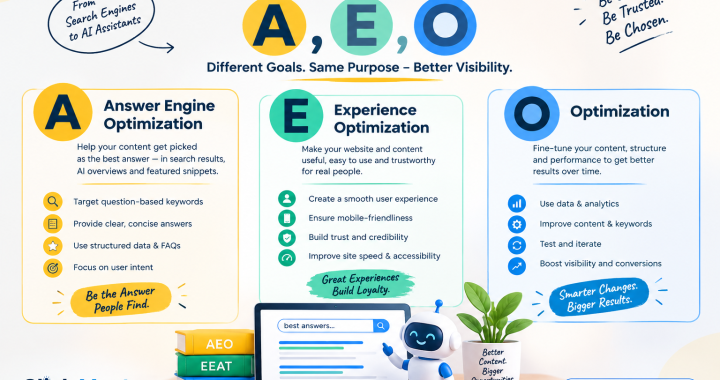
AEO: Answer Engine Optimization
What Is AEO?
AEO stands for Answer Engine Optimization. It is the practice of creating and organizing content so that it clearly answers the questions people ask through search engines and answer-focused digital experiences.
Today, users do not always search with short keywords. They often ask complete questions such as “What is digital marketing?” or “How can I improve my website traffic?” AEO focuses on understanding this user intent and providing a direct, useful and easy-to-understand answer.
The purpose of AEO is not simply to add keywords. It is about giving people the information they need in a clear and helpful format.
Why Is AEO Important?
AEO is becoming increasingly relevant as search becomes more conversational and answer-focused.
A good AEO strategy can help you:
- Understand and target real user questions.
- Create direct and useful answers.
- Improve content clarity and readability.
- Address different types of search intent.
- Organize information with clear headings.
- Provide useful examples and explanations.
- Build trust through accurate information.
- Make content easier to understand and navigate.
For example, instead of creating a page only around the topic “digital marketing,” you can answer related questions such as:
- What is digital marketing?
- Why is digital marketing important?
- How does digital marketing work?
- What are the main types of digital marketing?
- How can a small business use digital marketing?
This approach helps content address the actual needs of users instead of focusing only on individual keywords.
How Can You Improve AEO?
A practical AEO strategy includes:
- Research real questions: Find out what your audience wants to know.
- Answer directly: Give a clear answer before providing deeper details.
- Use natural language: Write as people actually speak and search.
- Structure content: Use headings, lists, tables and short paragraphs.
- Add context: Support answers with examples and useful explanations.
- Keep information updated: Review content when facts or practices change.
Google’s current guidance discusses AEO as a term used for efforts related to visibility in AI-assisted search experiences while emphasizing useful, unique and people-first content.
Frequently Asked Questions About AEO
What does AEO stand for?
AEO stands for Answer Engine Optimization. It focuses on creating content that directly and clearly answers users’ questions.
How is AEO different from traditional search optimization?
AEO places particular emphasis on questions, answers, conversational language and user intent. It is not a replacement for broader search optimization practices.
Does AEO guarantee that my content will appear as an answer?
No. There is no guaranteed method that can force a search or AI system to select a particular website as an answer.
How do I start AEO?
Start by researching genuine questions from your target audience and create clear, accurate and useful answers for those questions.
AEO Conclusion
AEO is fundamentally about answering people better. Instead of creating content only to target keywords, understand what your audience wants to know and provide a clear solution.
Understand the question → Give the answer → Add useful context → Build trust.
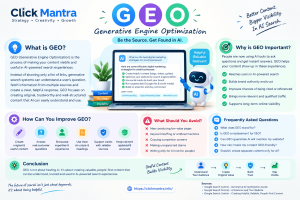
GEO: Generative Engine Optimization
What Is GEO?
GEO stands for Generative Engine Optimization. It is commonly used to describe efforts to improve the visibility and usefulness of content in generative AI search experiences.
Modern search can provide more than a traditional list of website links. Generative search systems may understand a user’s question, retrieve information from different sources and create a synthesized response.
For example, a user might ask:
“What digital marketing strategies can help a small business generate more leads?”
A generative search experience may provide an answer and potentially link to websites that contain useful supporting information.
GEO therefore focuses on creating content that is original, useful, trustworthy, well-structured and relevant to the user’s needs.
Why Is GEO Important?
The way people discover information is changing. Users increasingly use conversational questions and AI-powered search experiences to research products, services and topics.
A GEO-focused content strategy can help you:
- Create information around real user questions.
- Provide original insights and useful examples.
- Demonstrate relevant knowledge and experience.
- Make complicated topics easier to understand.
- Organize information into logical sections.
- Support important claims with reliable sources.
- Keep content accurate and updated.
- Make important information available in readable text.
- Improve the overall usefulness of your website.
How Can You Improve GEO?
A practical GEO strategy should focus on content quality rather than trying to find a secret AI-ranking trick.
1. Create Original Content
Do not simply rewrite information from other websites. Add your own insights, examples, research, experiences or useful explanations.
2. Answer Real Questions
Create content around the questions your customers actually ask. Clear answers can make your content more useful for both readers and modern search experiences.
3. Demonstrate Expertise
Use relevant author information, practical examples, case studies, original research and trustworthy references where appropriate.
4. Use Clear Structure
Use:
- Descriptive headings
- Short paragraphs
- Bullet points
- FAQs
- Tables where useful
- Internal links
- Examples and explanations
5. Keep Content Updated
Review important content regularly and update outdated information, statistics, examples and recommendations.
6. Maintain Technical Quality
Your website should remain accessible to search engines, mobile-friendly, secure and technically sound.
Google’s guidance states that there is no special technical requirement or guaranteed “GEO hack” for appearing in its AI search features. Existing search fundamentals and helpful, people-first content remain important.
Frequently Asked Questions About GEO
What does GEO stand for?
GEO commonly stands for Generative Engine Optimization. It refers to efforts aimed at improving content visibility and usefulness in generative AI search experiences.
Is GEO a replacement for SEO?
No. GEO should not be viewed as a replacement for broader search optimization. Google states that established search fundamentals remain important for AI search experiences.
Can GEO guarantee that an AI will mention my website?
No. AI and search systems decide which information to use based on their own systems and available sources. There is no guaranteed technique for forcing a particular website to be mentioned.
How can I make my content GEO-friendly?
Create original, useful and trustworthy content, answer genuine questions, provide clear explanations, demonstrate expertise and maintain good technical website practices.
Should I create separate content only for AI?
Not necessarily. Content should primarily provide value to people. A well-structured, useful page can serve both human readers and modern search experiences.
Can AI be used to create GEO content?
AI can assist with research, brainstorming and organization, but the final content should provide genuine value, accuracy and originality. Avoid mass-producing low-value pages simply to target AI search.
GEO Conclusion
GEO is not about manipulating AI systems. It is about creating valuable information that people can trust and understand.
A strong GEO approach can be summarized as:
Understand the user → Research the topic → Create original value → Answer clearly → Build trust → Keep improving.
As search continues to evolve, businesses that focus on useful, accurate and people-first content can build a stronger foundation for visibility across different search experiences.
Final Takeaway
AEO and GEO are closely connected to the changing way people discover information online.
AEO focuses on answering questions clearly, while GEO focuses on creating useful content for generative search experiences.
The common foundation is simple: understand your audience, solve their problems, provide trustworthy information and avoid creating content merely to manipulate search systems.
Sources
- Google Search Central — Guide to optimizing for generative AI features
- Google Search Central — AI features and your website
- Google Search Central — Creating helpful, reliable, people-first content
- Google Search Central — Search Essentials and spam policies
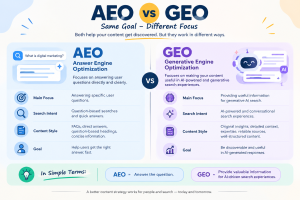
AEO vs GEO: What’s the Difference?
AEO (Answer Engine Optimization) focuses on creating content that directly answers specific user questions in a clear and concise way. It is mainly about understanding search intent and providing quick, useful answers.
GEO (Generative Engine Optimization) focuses on creating valuable, trustworthy, and well-structured content that can be useful in AI-powered and generative search experiences.
Simple Difference
- AEO: Focuses on answering the user’s question.
- GEO: Focuses on providing useful information for generative AI search.
- AEO: Uses FAQs, direct answers, question-based headings, and concise information.
- GEO: Uses original insights, detailed context, expertise, reliable sources, and well-structured content.
In simple terms:
AEO = Answer the question.
GEO = Provide valuable information for AI-driven search experiences.