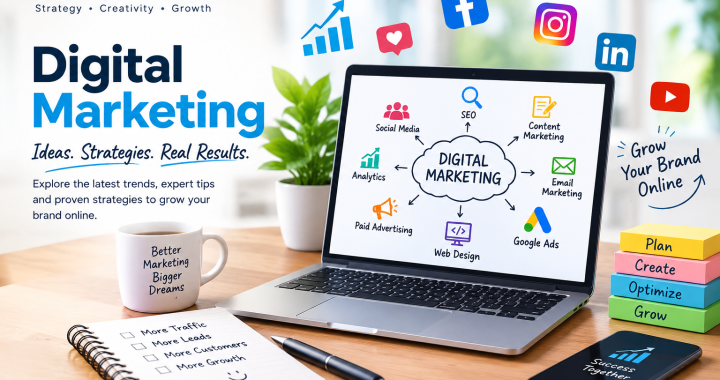
Digital Marketing: What It Is, Why It Matters, Core Strategies, Benefits & FAQs
Today, people search online before buying a product, choosing a service, visiting a business, or even deciding which brand they can trust. This change in customer behaviour has made an online presence an important part of modern business growth.
But simply having a website or social media account is not enough. Businesses need a clear strategy to reach the right audience, communicate their value, build trust, and turn online visitors into customers. This is where digital marketing becomes important.
What Is Digital Marketing?
Digital marketing is the process of promoting a business, product, service, or brand through digital channels such as search engines, websites, social media platforms, email, online advertising, and other internet-based channels.
In simple words, digital marketing means using online platforms to connect a business with the people who may be interested in what it offers.
For example, imagine that someone searches Google for a service offered by your business. Your website may appear in organic search results through SEO, or your business may appear through a paid advertisement.
Similarly, a potential customer might discover your brand through a social media post, watch a video about your product, read your blog, receive an email, or click on an online advertisement.
Google describes digital marketing as using channels such as social media, display advertising, email and search engines to attract and engage customers, encourage purchases and build customer loyalty.
Therefore, digital marketing is not simply about getting clicks. It is about creating useful interactions throughout the customer’s journey.
Why Is Digital Marketing Important?
Traditional marketing methods can still have value, but customers increasingly use digital channels to discover information and compare products and services.
Digital marketing helps businesses meet customers where they are already spending time: online.
1. Reach a Wider Audience
A local business can use digital channels to reach people beyond its immediate location. Depending on the business model, a campaign can target a specific city, region, country, or even an international audience.
This gives smaller businesses opportunities to compete for attention without relying only on traditional advertising.
2. Reach the Right Audience
Digital platforms provide different ways to define and reach audiences.
For example, paid advertising can be targeted according to factors such as location, interests, search intent, language, and other available audience signals.
Google Ads explains that online advertising can be targeted toward people who are more likely to be interested in a particular product or service.
3. Build Brand Awareness
Customers are more likely to remember businesses they repeatedly encounter through useful content, search results, social media, videos, emails, or advertising.
Consistent digital communication can help a brand develop a recognizable identity and communicate what makes it different.
4. Generate Leads and Sales
Digital marketing can support the entire customer journey—from creating awareness to encouraging a person to contact a business, request information, sign up, or make a purchase.
The goal is not simply to generate website traffic. The more meaningful objective is to attract relevant visitors and provide them with a clear path toward taking action.
5. Measure Marketing Performance
One of the major advantages of digital marketing is measurability.
Businesses can monitor metrics such as:
- Website traffic
- Leads
- Conversion rate
- Click-through rate
- Engagement
- Cost per lead
- Customer acquisition cost
- Return on advertising spend
- Email performance
This information can help marketers understand what is working and where improvements are needed.
Core Components of Digital Marketing
Digital marketing includes several interconnected channels. A business does not necessarily need to use every channel. The right combination depends on its audience, goals, industry, resources, and customer journey.
1. Search Engine Optimization (SEO)
SEO stands for Search Engine Optimization.
It involves improving a website and its content so that search engines can better understand the website and users can discover relevant information through search.
SEO can involve:
- Keyword research
- Helpful content creation
- On-page optimization
- Technical SEO
- Internal linking
- Website structure
- Mobile usability
- Page experience
- Authority and reputation building
SEO generally focuses on organic visibility rather than paying for each click.
Google’s explanation of SEO notes that optimization can help make a website more relevant to users and improve its visibility in search.
2. Social Media Marketing
Social media marketing uses social platforms to communicate with audiences, distribute content, build communities, increase awareness, and support business goals.
A strong social media strategy can include:
- Educational posts
- Short-form videos
- Product or service content
- Customer-focused content
- Brand stories
- Community engagement
- Promotional campaigns
The focus should not be only on collecting likes. Meaningful engagement and the ability to connect with the right audience are often more valuable.
3. Content Marketing
Content marketing focuses on creating useful and relevant information for a specific audience.
Examples include:
- Blog articles
- Guides
- Case studies
- Videos
- Infographics
- Tutorials
- FAQs
- Social media content
Good content answers real questions instead of simply trying to sell something.
For example, instead of writing an article that repeatedly promotes a service, a business can create a useful guide that solves a problem faced by its target audience and naturally introduce its service where appropriate.
4. Pay-Per-Click Advertising
PPC advertising allows businesses to pay for online advertising opportunities according to the advertising platform and campaign model.
Google Ads is one example. Businesses can create advertisements that may appear when users search for relevant terms.
Google explains that advertisers can set and control their budgets and measure campaign performance.
PPC can be useful when a business wants to reach people with specific search or audience signals more quickly than organic strategies may allow.
5. Email Marketing
Email marketing allows businesses to communicate directly with people who have opted to receive their messages.
It can be used for:
- Newsletters
- Product updates
- Educational content
- Offers
- Follow-ups
- Customer retention
- Automated communication
Effective email marketing focuses on relevance rather than sending large numbers of unnecessary messages.
6. Website Marketing
A website is often the central destination for digital marketing activity.
SEO may bring visitors to the website. Social media may introduce people to the brand. Paid advertising may generate targeted traffic. Content may answer their questions.
But the website still needs to provide a good experience.
Important elements include:
- Clear navigation
- Helpful information
- Mobile-friendly design
- Fast and accessible pages
- Strong calls to action
- Trust signals
- Simple contact options
- Relevant landing pages
A marketing campaign can attract visitors, but the website must help those visitors understand what the business offers and what they should do next.
7. Analytics and Conversion Optimization
Analytics helps marketers understand what visitors and customers are doing.
For example, a business may discover that a particular landing page receives substantial traffic but generates very few enquiries.
That insight can lead to improvements in the page’s content, design, messaging, form, offer, or call to action.
Digital marketing therefore works as a continuous cycle:
Plan → Create → Reach → Measure → Learn → Improve
How Does Digital Marketing Help a Business Grow?
Digital marketing can support several stages of business growth.
Awareness
Potential customers first need to discover that your business exists.
SEO, social media, content, video and advertising can help increase visibility.
Consideration
After discovering a brand, people usually need more information before taking action.
Helpful content, detailed service pages, reviews, case studies and clear website information can support this stage.
Conversion
The customer now needs a simple reason and path to take action.
This could mean:
- Making a purchase
- Filling out a form
- Calling the business
- Booking a consultation
- Signing up
- Requesting a quotation
Retention
Marketing should not stop after the first conversion.
Email marketing, useful content, customer support, loyalty communication and ongoing engagement can help businesses maintain relationships with existing customers.
Digital Marketing Is Not Only About Advertising
A common misunderstanding is that digital marketing means running advertisements.
Advertising is only one part of the larger picture.
For example, a business may spend money bringing visitors to a website through paid advertising. But if the website is difficult to use, the information is unclear, or there is no strong reason to take action, the campaign may not produce the expected business outcome.
This is why digital marketing works best when different activities support each other.
SEO can build organic visibility.
Content can answer customer questions.
Social media can strengthen communication.
Paid advertising can provide targeted reach.
Email can support customer relationships.
Analytics can show what needs improvement.
Together, these activities can create a more complete marketing system.
How to Create a Simple Digital Marketing Strategy
A practical strategy does not need to be complicated.
Step 1: Understand Your Audience
Start by identifying:
- Who are your customers?
- What problems do they have?
- What are they searching for?
- What information do they need?
- What prevents them from making a decision?
Step 2: Define Your Goal
Your goal could be:
- Brand awareness
- Website traffic
- Lead generation
- Online sales
- App downloads
- Customer retention
- Local enquiries
A clear goal makes it easier to select the right channels and metrics.
Step 3: Select the Right Channels
Do not automatically use every available platform.
Choose channels based on where your audience is and how they make decisions.
Step 4: Create Useful Content
Content should answer genuine questions and provide a reason for people to trust your business.
Avoid writing solely for search engines. Write for people first while following sound SEO practices.
Step 5: Measure the Results
Track meaningful business metrics rather than focusing only on vanity numbers.
For example, a large number of social media impressions may look impressive, but qualified leads and conversions may provide more useful information about business performance.
Step 6: Improve Continuously
Digital marketing is not a one-time activity.
Customer behaviour, competitors, platforms, search experiences and business objectives can change. Regular analysis and improvement are therefore important.
Common Digital Marketing Mistakes to Avoid
Even a well-planned campaign can lose effectiveness because of basic mistakes.
Some common problems include:
- Targeting everyone instead of a defined audience
- Publishing content without a clear purpose
- Focusing only on follower counts
- Ignoring website usability
- Using irrelevant keywords
- Expecting instant SEO results
- Running ads without conversion tracking
- Sending irrelevant emails
- Copying competitors instead of developing original ideas
- Changing strategy too frequently without enough data
A better approach is to understand the customer, establish realistic objectives, measure meaningful outcomes, and improve based on evidence.
Frequently Asked Questions About Digital Marketing
What is digital marketing in simple words?
Digital marketing means promoting and growing a business through online channels such as search engines, websites, social media, email, content and digital advertising.
Why is digital marketing important?
It helps businesses connect with online audiences, build awareness, generate relevant traffic and leads, communicate with customers, and measure marketing performance.
What are the main types of digital marketing?
Common areas include SEO, social media marketing, content marketing, email marketing, PPC advertising, website marketing, online reputation activities and analytics.
Is SEO part of digital marketing?
Yes. SEO is one of the major components of digital marketing and focuses on improving a website’s organic visibility in search engines.
Is digital marketing useful for small businesses?
Yes. Small businesses can use digital channels to reach relevant audiences, build their online presence, communicate with customers and compete for attention. The key is choosing channels that match their business goals and audience.
Salesforce’s small-business guidance similarly identifies SEO, social media, email marketing, content and search marketing as important digital marketing activities for smaller businesses.
How long does digital marketing take to show results?
There is no single timeline.
Some paid campaigns can begin generating traffic soon after launch, while SEO and content strategies often require consistent work and time before their impact becomes clear.
Results also depend on competition, industry, website quality, audience, budget, offer, content quality and execution.
Is digital marketing only for large companies?
No. Businesses of different sizes can use digital marketing. The strategy, budget, channels and objectives should be adjusted according to the business.
What should a beginner learn first?
A beginner should first understand the fundamentals of audience research, SEO, content, social media, paid advertising, analytics and conversion optimization.
More importantly, learn how these areas work together rather than treating each channel as a completely separate activity.
Conclusion
Digital marketing has changed the way businesses communicate with customers. Instead of depending only on traditional advertising, businesses can use search engines, websites, social media, content, email and online advertising to build visibility and create meaningful customer relationships.
However, successful digital marketing is not about being everywhere or chasing every new trend. It is about understanding your audience, choosing appropriate channels, creating useful experiences, measuring meaningful results and improving consistently.
The strongest digital strategy starts with a simple question:
What does my customer need, and how can my business help them?
Once that question is clear, digital marketing becomes more than a collection of online activities. It becomes a structured way to connect the right audience with the right message at the right stage of their journey.
For businesses looking to grow online, the real opportunity is not simply to get more clicks. It is to turn attention into trust, trust into action, and action into long-term customer relationships.
Final Takeaway
Digital marketing is an ongoing process of connecting, communicating, measuring and improving.
Whether you are a startup, local business, service provider, e-commerce brand or established company, a thoughtful digital strategy can help you build a stronger online presence and create a clearer path from discovery to conversion.
The goal should always be simple: provide value to the audience first and build business growth around that value.
Sources
- Google Ads Help — Online Marketing and Digital Advertising: Google Ads Help
- Google Ads Help — Google Ads Definition: Google Ads Help
- Google — Digital Marketing & E-commerce: Grow with Google
- Google — SEO vs. PPC: Google Business
- Salesforce — Digital Marketing for Small Businesses: Salesforce