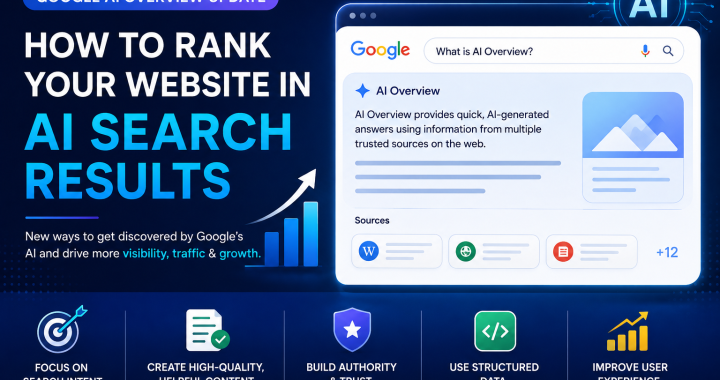
Google AI Overview Update: How to Rank Your Website in AI Search Results
Introduction
Search engine optimization has entered a new era. For years, businesses focused on ranking websites on Google’s first page by optimizing keywords, building backlinks, and creating high-quality content. While these strategies are still important, Google’s latest AI Overview update is changing the way users discover information online.
AI Overviews are transforming traditional search results by providing users with direct, AI-generated answers at the top of the search page. Instead of clicking through multiple websites, users can now receive summarized information instantly.
For website owners, marketers, and businesses, this change presents both challenges and opportunities. The question is no longer just how to rank on Google, but how to become one of the sources Google’s AI chooses when generating answers.
In this guide, we’ll explore what Google AI Overviews are, why they matter, and how you can optimize your website to rank in AI-driven search results.
What Is Google AI Overview?
Google AI Overview is an advanced search feature powered by artificial intelligence that generates concise answers to user queries directly within search results.
Instead of showing only a list of links, Google analyzes information from multiple trusted sources and creates an AI-generated response that helps users find answers quickly.
For example, if someone searches:
“How can small businesses improve SEO in 2026?”
Google may generate a detailed summary highlighting key strategies and then provide links to supporting websites.
This means websites must now compete not only for traditional rankings but also for visibility within AI-generated responses.
Why AI Overviews Are Changing SEO
The AI Overview update represents one of the biggest changes in search history.
Traditionally, users clicked on one of the top search results to find information. Today, many users receive answers without leaving Google’s search page.
This trend is known as a “zero-click search.”
As AI-generated summaries become more common, businesses must adapt their SEO strategies to remain visible.
The websites that provide accurate, trustworthy, and well-structured information are more likely to be referenced by Google’s AI systems.
In simple terms, Google is rewarding expertise and helpful content more than ever before.
How Google Selects Content for AI Overviews
While Google has not revealed every detail about its AI selection process, several factors appear to influence whether content is included in AI-generated answers.
Content Quality
Google prioritizes content that is accurate, comprehensive, and genuinely helpful.
Thin content created solely to target keywords is unlikely to perform well.
Expertise and Authority
Websites demonstrating industry expertise are more likely to be trusted by AI systems.
This is particularly important for digital marketing, finance, health, and other competitive industries.
Relevance to Search Intent
Google evaluates whether content directly answers a user’s question.
Pages that solve specific problems tend to perform better.
Website Trustworthiness
Secure websites, strong reputations, and positive user experiences contribute to trust signals.
Structured Information
Clearly organized content helps AI understand and extract information efficiently.
Focus on Search Intent, Not Just Keywords
One of the biggest mistakes businesses make is creating content around keywords rather than user needs.
AI-powered search is designed to understand intent.
For example:
Traditional SEO Target:
- Digital marketing services
Intent-Based SEO Target:
- How can digital marketing services help small businesses grow?
The second approach provides context and directly addresses a user’s question.
To improve your chances of appearing in AI Overviews:
- Understand what users want to know
- Answer questions clearly
- Provide practical solutions
- Create content around real customer problems
The better you satisfy search intent, the better your chances of AI visibility.
Create Content That Answers Questions
Google AI Overviews are designed to provide answers.
Therefore, content that directly addresses questions has a greater chance of being featured.
Consider using question-based headings such as:
What Is Local SEO?
How Does Google AI Overview Work?
Why Is AI Changing SEO?
How Can Businesses Improve Organic Traffic?
Each section should provide a clear and concise answer before expanding on the topic.
This structure makes it easier for Google’s AI systems to understand and reference your content.
Build Topical Authority
Google increasingly favors websites that demonstrate expertise in a specific subject area.
Instead of publishing unrelated content, focus on building authority around your niche.
For a digital marketing agency, content topics might include:
- SEO
- Technical SEO
- Local SEO
- Google Ads
- Content Marketing
- Social Media Marketing
- AI in Marketing
The more valuable content you publish within your industry, the more Google recognizes your website as a trusted resource.
Topical authority increases your chances of being referenced in AI-generated search results.
Use Clear Content Structure
AI systems prefer content that is easy to understand.
A well-structured article helps both users and search engines.
Best practices include:
Use Descriptive Headings
Break content into logical sections.
Create Short Paragraphs
Avoid large blocks of text.
Use Bullet Points
Highlight key information clearly.
Include FAQs
Frequently asked questions align perfectly with AI-generated search experiences.
Add Tables and Comparisons
Organized information is easier for AI to analyze.
The easier your content is to scan, the more likely AI systems can extract useful information.
Optimize for E-E-A-T
Google places significant emphasis on E-E-A-T:
Experience
Show real-world knowledge and examples.
Expertise
Demonstrate industry understanding.
Authoritativeness
Build recognition within your niche.
Trustworthiness
Provide accurate information and maintain website credibility.
Businesses that establish strong E-E-A-T signals are more likely to gain visibility in AI Overviews.
Examples include:
- Publishing case studies
- Sharing client success stories
- Creating original research
- Including expert opinions
These factors help Google view your website as a reliable source.
Improve Technical SEO
While content quality is crucial, technical SEO still matters.
Google’s AI systems need to crawl and understand your website efficiently.
Important technical SEO factors include:
Fast Page Speed
Slow websites negatively impact user experience.
Mobile Optimization
Most searches occur on mobile devices.
Secure HTTPS Connection
Website security remains an important ranking factor.
Clean Site Architecture
Logical navigation improves crawlability.
Schema Markup
Structured data helps search engines understand content more effectively.
Technical optimization creates a strong foundation for AI-driven visibility.
Create Original Content
One challenge of the AI era is content saturation.
Thousands of websites now publish AI-generated articles every day.
Generic content rarely stands out.
To improve your chances of appearing in AI Overviews:
- Share original insights
- Publish industry research
- Include expert commentary
- Add real examples
- Provide unique perspectives
Google’s AI seeks valuable information, not repetitive content.
Originality has become a major competitive advantage.
Optimize for Conversational Search
Users are increasingly searching in a conversational manner.
Instead of typing:
“SEO tips”
They may ask:
“What are the best SEO strategies for small businesses in 2026?”
Google AI is designed to understand natural language.
To optimize for conversational search:
- Write naturally
- Use question-based content
- Include FAQ sections
- Address long-tail keywords
- Answer complete questions
This approach aligns perfectly with AI-driven search behavior.
Monitor User Experience Signals
AI-powered ranking systems pay close attention to how users interact with websites.
Positive engagement signals include:
- Longer time on page
- Lower bounce rates
- Higher click-through rates
- Better user satisfaction
To improve user experience:
- Make content easy to read
- Use visuals and graphics
- Improve page speed
- Simplify navigation
- Ensure mobile responsiveness
A positive user experience increases both traditional rankings and AI visibility.
Common Mistakes to Avoid
Many businesses struggle with AI SEO because they continue using outdated strategies.
Avoid these mistakes:
- Keyword stuffing
- Publishing low-quality AI-generated content
- Ignoring user intent
- Creating duplicate content
- Neglecting technical SEO
- Focusing only on rankings instead of value
Google’s AI rewards helpful content, not manipulation.
The Future of AI Search Optimization
Google AI Overviews represent only the beginning of AI-powered search.
Future developments may include:
- More personalized search experiences
- Enhanced conversational search
- Greater emphasis on expertise
- Increased use of multimedia content
- More sophisticated AI-generated answers
Businesses that adapt early will have a significant advantage.
The focus will continue shifting from search engine optimization to user experience optimization.
Conclusion
Google’s AI Overview update is transforming how websites gain visibility online. Traditional SEO remains important, but success now requires a deeper focus on expertise, user intent, content quality, and trustworthiness.
Businesses that create valuable content, establish authority, and prioritize user experience will be better positioned to appear in AI-generated search results.
Rather than viewing AI Overviews as a threat, smart marketers should see them as an opportunity. By becoming a trusted source of information, your website can earn visibility not only in traditional rankings but also within Google’s AI-powered answers.
The future of SEO belongs to businesses that combine human expertise with AI-friendly optimization strategies.
Frequently Asked Questions (FAQs)
1. What is Google AI Overview?
Google AI Overview is an AI-powered search feature that generates summarized answers directly within search results using information from trusted sources.
2. How can my website appear in AI Overviews?
Create high-quality content, answer user questions clearly, build topical authority, and demonstrate expertise and trustworthiness.
3. Does traditional SEO still matter?
Yes. Technical SEO, backlinks, content quality, and user experience remain important ranking factors.
4. Are AI Overviews reducing website traffic?
Some informational searches may result in fewer clicks, but websites featured as trusted sources can gain increased visibility and authority.
5. What is the most important ranking factor for AI search results?
Content quality, relevance, user intent satisfaction, expertise, and trustworthiness are among the most important factors.