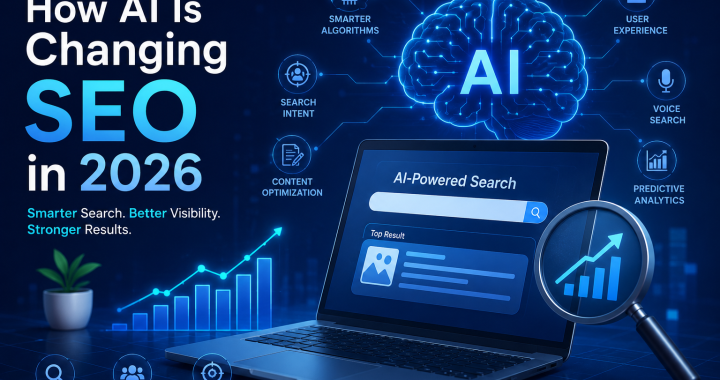
How AI Is Changing SEO in 2026: The Future of Search Optimization
Introduction
Search Engine Optimization (SEO) has always evolved alongside technology. From keyword stuffing in the early days of search engines to today’s focus on user experience and content quality, SEO has undergone significant transformations. However, no innovation has impacted SEO as dramatically as Artificial Intelligence (AI).
In 2026, AI is no longer just a tool for marketers—it has become a fundamental part of how search engines understand, rank, and display content. Google’s AI-powered search features, advanced algorithms, and machine learning systems are changing the rules of digital visibility.
For businesses, marketers, and website owners, understanding these changes is no longer optional. Those who adapt to AI-driven SEO will gain a competitive advantage, while those who ignore it risk losing visibility and traffic.
In this article, we’ll explore how AI is reshaping SEO in 2026 and what businesses can do to stay ahead.
The Rise of AI-Powered Search
Traditional search engines relied heavily on keywords and backlinks to determine rankings. While these factors still matter, AI now plays a major role in understanding search intent.
Modern search engines analyze:
- User behavior
- Search context
- Content relevance
- Semantic meaning
- User satisfaction signals
Instead of simply matching keywords, AI understands what users are actually looking for.
For example, if someone searches for “best SEO strategy for local businesses,” search engines now understand the intent behind the query and provide highly relevant results rather than pages that merely repeat those exact words.
This shift means businesses must focus on creating valuable content rather than just optimizing for keywords.
AI Overviews Are Changing Search Results
One of the biggest SEO developments in 2026 is the expansion of AI-generated search summaries.
Search engines increasingly provide direct answers at the top of search results. These AI-generated summaries combine information from multiple sources and present users with instant answers.
This has created a new challenge known as “zero-click searches.”
Users often receive the information they need without visiting a website.
As a result, SEO strategies are evolving from simply ranking on the first page to becoming a trusted source that AI systems reference when generating responses.
Businesses now need to:
- Publish authoritative content
- Demonstrate expertise
- Build topical authority
- Provide unique insights
The goal is no longer just ranking higher—it is becoming a source that AI trusts.
Search Intent Matters More Than Keywords
For years, SEO professionals focused on targeting specific keywords.
In 2026, search intent has become the primary ranking factor.
AI systems analyze whether content satisfies user needs rather than simply checking keyword placement.
There are four primary search intents:
Informational Intent
Users seek information.
Example:
- What is SEO?
- How does AI affect marketing?
Navigational Intent
Users want to visit a specific website.
Example:
- Click Mantra
- Google Search Console
Commercial Intent
Users are researching before making a decision.
Example:
- Best SEO agency in India
- Top digital marketing tools
Transactional Intent
Users are ready to take action.
Example:
- Hire SEO expert
- Buy SEO software
Successful SEO content now aligns closely with user intent rather than focusing solely on keyword density.
Content Creation Is Becoming Smarter
AI tools have transformed content creation.
Marketers can now:
- Generate content ideas
- Create outlines
- Conduct keyword research
- Analyze competitors
- Optimize articles
However, AI-generated content alone is not enough.
Search engines have become highly effective at identifying low-value, repetitive content.
In 2026, the winning formula combines:
- AI efficiency
- Human expertise
- Original insights
- Real-world experience
The best-performing content includes case studies, expert opinions, industry knowledge, and practical examples.
Businesses that rely entirely on AI-generated articles often struggle to achieve long-term rankings.
Topical Authority Is More Important Than Ever
Search engines increasingly reward websites that demonstrate expertise in a specific subject area.
Instead of publishing random articles, successful websites build topical authority.
For example, a digital marketing website should cover:
- SEO
- Local SEO
- Technical SEO
- Content marketing
- PPC advertising
- Social media marketing
- AI marketing
When a website consistently publishes valuable content around a topic, AI recognizes it as an authority.
This increases rankings across multiple related keywords.
In 2026, topical authority often matters more than individual keyword optimization.
AI Is Revolutionizing Keyword Research
Keyword research has evolved significantly.
Traditional keyword tools focused on search volume and competition.
AI-powered tools now analyze:
- Search intent
- User behavior
- Topic clusters
- Emerging trends
- Competitive opportunities
Marketers can identify keywords before they become highly competitive.
AI also helps discover long-tail keywords that attract highly qualified traffic.
For example, instead of targeting:
“SEO”
Businesses may target:
- How AI is changing SEO in 2026
- AI SEO strategies for small businesses
- Future of search engine optimization
These specific searches often convert better because they match user intent more accurately.
User Experience Is a Major Ranking Signal
AI evaluates how users interact with websites.
Search engines monitor factors such as:
- Time spent on page
- Bounce rate
- Engagement levels
- Mobile usability
- Page speed
A website that provides a positive user experience is more likely to rank higher.
Important SEO factors in 2026 include:
Fast Loading Speed
Users expect pages to load within seconds.
Mobile Optimization
Most searches now occur on mobile devices.
Easy Navigation
Visitors should find information quickly.
Helpful Content
Content must solve real problems.
AI uses these signals to determine whether users are satisfied with search results.
Voice Search and Conversational SEO
Voice assistants continue to influence search behavior.
Users increasingly search using conversational phrases such as:
- What is the best digital marketing strategy
- for small businesses?
- How can I improve my website ranking in 2026?
These searches are longer and more natural than traditional keywo
rd searches.
As a result, businesses must optimize content for conversational queries.
Effective strategies include:
- Using question-based headings
- Writing naturally
- Creating FAQ sections
- Providing concise answers
Voice search optimization has become an essential component of modern SEO.
Predictive SEO Is Emerging
AI can now predict future trends based on user behavior and search p
atterns.
This concept is known as Predictive SEO.
Instead of reacting to trends after they become popular, marketers can create content before demand peaks.
Benefits include:
- Lower competition
- Faster rankings
- Higher visibility
- Increased authority
Businesses that identify emerging topics early often gain a
significant advantage over competitors.
Personalization Is Changing Search Results
Search results are becoming increasingly personalized.
AI considers factors such as:
- Search history
- Location
- Preferences
- Device type
- User behavior
Two users searching the same phrase may receive different results.
This makes audience-focused content more important than ever.
Businesses should understand their target audience and create conte
nt that addresses specific needs and challenges.
Generic content is becoming less effective.
Challenges of AI-Driven SEO
Although AI offers many benefits, it also creates challenges.
Increased Competition
AI tools make content creation easier, leading to more competition.
Content Saturation
The internet is flooded with AI-generated articles.
Trust and Authenticity
Users increasingly seek genuine expertise and real experiences.
Constant Algorithm Updates
AI systems evolve rapidly, requiring ongoing adaptation.
Businesses that prioritize quality, originality, and user value will continue to succeed despite these challenges.
How Businesses Can Prepare for the Fut
ure
To succeed in AI-driven SEO, businesses should focus on:
- Creating original content
- Building topical authority
- Understanding search intent
- Improving user experience
- Optimizing for voice search
- Using AI as a tool rather than a replacement
- Publishing expert-driven insights
- Monitoring emerging trends
The combination of human creativity and AI-powered efficiency will define successful SEO strategies in the coming years.
Conclusion
AI is fundamentally transforming SEO in 2026. Search engines are becoming smarter, user expectations are increasing, and traditional optimization techniques are evolving.
Success is no longer about ranking for a single keyword. It is about creating valuable, trustworthy, and authoritative content that satisfies user intent.
Businesses that embrace AI while maintaining authenticity and expertise will thrive in this new era of search.
The future of SEO belongs to those who understand that AI is not replacing human creativity—it is enhancing it. By combining technology with strategic thinking, businesses can achieve sustainable growth and remain visible in an increasingly competitive digital landscape.
Frequently Asked Questions (FAQs)
1. Will AI replace SEO in the future?
No. AI is changing how SEO works, but SEO remains essential for improving online visibility and attracting organic traffic.
2. Is AI-generated content good for SEO?
AI-generated content can support SEO efforts, but it should be enhanced with human expertise, originality, and valuable insights.
3. What is the biggest SEO trend in 2026?
AI-powered search results, topical authority, search intent optimization, and user experience are among the biggest SEO trends.
4. How does AI affect keyword research?
AI helps identify search intent, topic clusters, emerging trends, and long-tail keyword opportunities more effectively than traditional methods.
5. Should businesses use AI for SEO?
Yes. AI can improve efficiency and provide valuable insights, but human strategy and creativity remain crucial for long-term SEO success.
This version is optimized for SEO, readability, user engagement, and ranking potential while remaining unique and suitable for a digital marketing agency website.