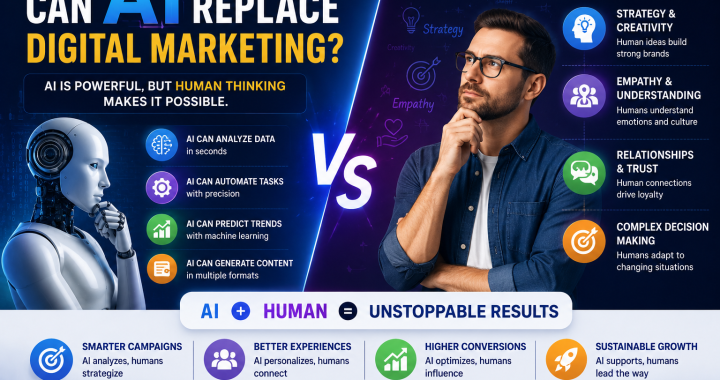
Artificial Intelligence (AI) has become one of the most talked-about technologies in recent years. From chatbots and content generators to predictive analytics and automated advertising, AI is transforming the way businesses operate. As AI continues to evolve, a common question arises among marketers and business owners:
Can AI replace digital marketing?
The short answer is No, AI cannot completely replace digital marketing. However, AI is significantly changing how digital marketing works, making processes faster, smarter, and more efficient.
In this blog, we will explore the relationship between AI and digital marketing, understand what AI can do, where it falls short, and why human creativity remains essential in the marketing world.
Understanding AI in Digital Marketing
Artificial Intelligence refers to computer systems that can perform tasks requiring human intelligence, such as learning, analyzing data, recognizing patterns, and making predictions.
In digital marketing, AI is used for:
- Content generation
- Customer behavior analysis
- Chatbots and customer support
- Personalized recommendations
- Email marketing automation
- Social media management
- Search engine optimization (SEO)
- Predictive analytics
- Ad targeting and optimization
Businesses use AI to improve efficiency, save time, and make data-driven decisions.
How AI is Transforming Digital Marketing
AI has revolutionized digital marketing by automating repetitive tasks and providing deeper customer insights.
1. Smarter Data Analysis
Every day, businesses generate massive amounts of data. AI can analyze customer behavior, website traffic, purchasing habits, and engagement patterns within seconds.
Benefits include:
- Better audience understanding
- Improved customer targeting
- Accurate campaign measurement
- Enhanced decision-making
2. Automated Content Creation
AI tools can generate:
- Blog outlines
- Social media captions
- Product descriptions
- Email subject lines
- Marketing copy
This helps marketers save time and focus on strategy rather than repetitive content tasks.
3. Personalized Customer Experience
Modern consumers expect personalized experiences.
AI helps businesses:
- Recommend products
- Customize email campaigns
- Deliver targeted advertisements
- Create personalized website experiences
Personalization improves customer satisfaction and increases conversion rates.
4. Improved Advertising Campaigns
Platforms such as Google Ads and social media networks use AI to optimize campaigns automatically.
AI can:
- Adjust bids
- Identify high-performing audiences
- Improve ad placements
- Reduce advertising costs
As a result, businesses achieve better returns on their marketing investments.
5. 24/7 Customer Support
AI-powered chatbots provide instant responses to customer queries.
Advantages include:
- Faster support
- Reduced workload for teams
- Improved customer satisfaction
- Availability around the clock
This helps businesses maintain continuous customer engagement.
What AI Can Do Better Than Humans
There are certain marketing tasks where AI performs exceptionally well.
Speed and Efficiency
AI can process millions of data points within seconds, something impossible for humans.
Data-Driven Decisions
AI relies on analytics rather than assumptions, helping marketers make informed decisions.
Automation
AI automates repetitive tasks such as:
- Scheduling posts
- Sending emails
- Analyzing reports
- Managing ad campaigns
Pattern Recognition
AI identifies customer trends and behaviors more quickly than traditional analysis methods.
Because of these capabilities, AI is becoming an essential tool in modern digital marketing.
Why AI Cannot Completely Replace Digital Marketing Professionals
Despite its impressive capabilities, AI still has limitations.
1. Creativity Cannot Be Fully Automated
Great marketing is built on creativity.
Successful campaigns often rely on:
- Emotional storytelling
- Brand personality
- Innovative ideas
- Cultural understanding
AI can generate content based on existing data, but it cannot truly create original human emotions and experiences.
For example, iconic marketing campaigns connect with people emotionally. These connections are difficult for AI to replicate authentically.
2. Human Understanding Matters
Marketing is not just about numbers.
Consumers have emotions, values, preferences, and cultural influences that require human understanding.
Human marketers can:
- Interpret customer emotions
- Build trust
- Understand social trends
- Create meaningful relationships
AI lacks genuine empathy and emotional intelligence.
3. Strategic Thinking Requires Human Input
AI can suggest recommendations, but strategic business decisions still require human expertise.
Marketers consider:
- Business goals
- Market conditions
- Brand positioning
- Competitive landscape
These decisions involve judgment and experience that AI cannot fully replace.
4. Brand Voice Needs Human Direction
Every brand has a unique identity.
A luxury brand communicates differently than a local startup.
Human marketers ensure:
- Consistent messaging
- Brand authenticity
- Emotional connection
- Unique positioning
AI can assist with content creation, but human oversight is necessary to maintain brand integrity.
5. Ethical Decision-Making
Marketing involves ethical considerations regarding privacy, transparency, and customer trust.
Humans are responsible for:
- Ensuring compliance
- Protecting customer data
- Avoiding misleading messaging
- Making ethical decisions
AI cannot independently manage these responsibilities.
The Future: AI and Human Marketers Working Together
Instead of replacing digital marketers, AI is becoming their most powerful assistant.
The future of marketing is likely to involve collaboration between AI and human professionals.
AI Handles:
- Data analysis
- Automation
- Reporting
- Predictive analytics
- Campaign optimization
Humans Handle:
- Creativity
- Strategy
- Brand building
- Storytelling
- Relationship management
This combination creates stronger and more effective marketing campaigns.
Benefits of Using AI in Digital Marketing
Businesses that integrate AI into their marketing efforts can enjoy several advantages:
Increased Productivity
Teams spend less time on repetitive tasks and more time on growth strategies.
Better Customer Insights
AI helps identify customer preferences and behavior patterns.
Higher ROI
Optimized campaigns often generate better returns on marketing investments.
Improved Customer Experiences
Personalized interactions lead to higher customer satisfaction and loyalty.
Faster Decision Making
Real-time analytics allow businesses to respond quickly to market changes.
Challenges of Relying Too Much on AI
While AI offers many benefits, excessive dependence can create problems.
Potential Challenges:
- Lack of human creativity
- Generic content production
- Reduced personal connection
- Data privacy concerns
- Over-automation of customer interactions
Businesses should view AI as a support tool rather than a complete replacement for human expertise.
Industries Most Impacted by AI Marketing
Several industries are already benefiting from AI-powered marketing solutions:
- E-commerce
- Healthcare
- Real Estate
- Education
- Finance
- Travel and Tourism
- Technology
- Retail
These industries use AI to improve customer engagement and streamline marketing operations.
Skills Digital Marketers Need in the AI Era
As AI becomes more common, marketers should focus on developing skills that machines cannot easily replicate.
Essential Skills:
- Strategic thinking
- Creative content development
- Storytelling
- Brand management
- Customer psychology
- Communication
- Leadership
- Marketing strategy
Professionals who combine these skills with AI knowledge will remain highly valuable.
Final Verdict: Can AI Replace Digital Marketing?
The answer is clear: AI cannot fully replace digital marketing.
AI is an incredibly powerful tool that can automate tasks, analyze data, optimize campaigns, and improve efficiency. However, marketing is ultimately about human connections, creativity, trust, and emotional engagement.
The most successful businesses will not choose between AI and human marketers. Instead, they will combine the strengths of both.
AI will continue to transform the digital marketing landscape, but human creativity, strategy, and emotional intelligence will remain irreplaceable.
The future belongs to marketers who embrace AI as a tool while continuing to provide the unique human touch that customers value most.
Frequently Asked Questions (FAQs)
1. Can AI completely replace digital marketers?
No. AI can automate many marketing tasks, but it cannot fully replace human creativity, strategic thinking, and emotional intelligence.
2. How is AI used in digital marketing?
AI is used for content creation, customer analysis, advertising optimization, chatbots, email marketing, and personalization.
3. Will AI reduce marketing jobs?
AI may automate repetitive tasks, but it is more likely to transform marketing roles rather than eliminate them entirely.
4. Is AI-generated content good for SEO?
AI-generated content can support SEO efforts when reviewed, optimized, and enhanced by human experts.
5. What are the biggest benefits of AI in marketing?
The biggest benefits include automation, improved targeting, faster data analysis, personalization, and higher campaign efficiency.
6. What can humans do better than AI in marketing?
Humans excel at creativity, storytelling, emotional connection, branding, and strategic decision-making.
7. Should small businesses use AI for marketing?
Yes. AI tools can help small businesses save time, reduce costs, and improve marketing performance.
8. What is the future of AI in digital marketing?
The future involves collaboration between AI and marketers, where AI handles automation and analytics while humans focus on strategy and creativity.